
In large-scale photovoltaic projects, execution efficiency is no longer a competitive advantage — it is a requirement. As solar plants increase in size and complexity, EPCs and asset owners are under growing pressure to reduce installation timelines, optimize labor, and minimize on-site risk.
In this context, solar tracker pre-assembly of the main components has become one of the most effective levers to improve field performance. When embedded into the product design from the very beginning, pre-assembly fundamentally transforms how solar projects are built.
At Gonvarri Solar Steel, pre-assembly is not an optional add-on. It is an integral part of our engineering philosophy.
What Is Pre-Assembly in Solar Trackers?
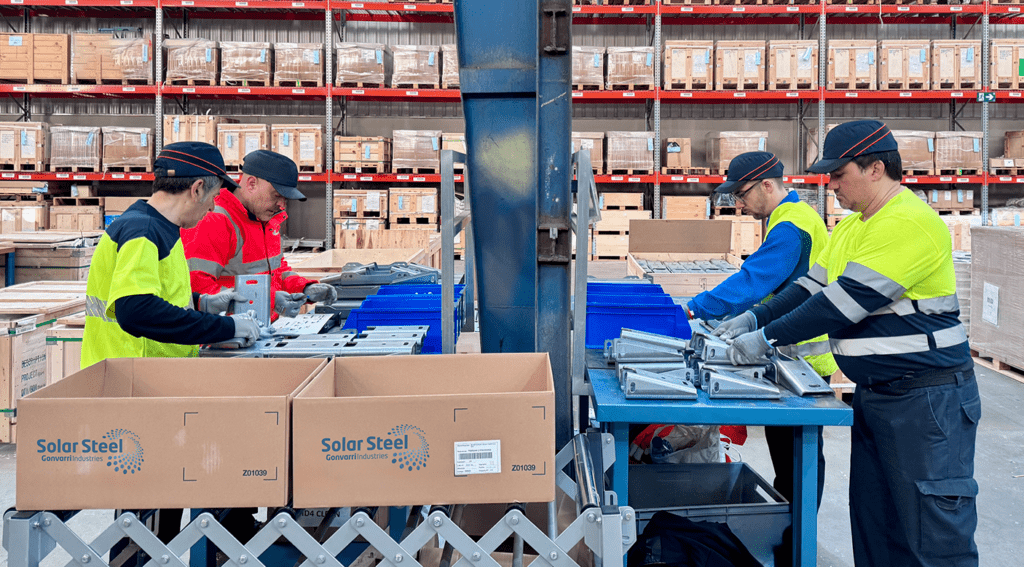
Pre-assembly refers to the factory-level integration of the main tracker components before they are shipped to site. Instead of assembling structural and mechanical elements entirely in the field, critical parts are pre-mounted under controlled industrial conditions.
This typically includes:
- Structural subassemblies
- Mechanical interfaces
- Key connection points
The result is a system that arrives on site ready for rapid installation, with fewer manual operations and fewer variables during construction.
Why Pre-Assembly Matters in Utility-Scale Solar Projects
1. Reduced Installation Time
One of the most common questions searched in Google is:
“How can I reduce solar tracker installation time?”
Time studies carried out on real installations show that integrated pre-assembly can generate time savings of more than 5% compared to standard industry approaches. This reduction is not theoretical — it is measured on-site, under real project conditions.
By minimizing the number of manual assembly steps in the field:
- Crews move faster
- Installation sequences are simplified
- Bottlenecks during peak construction phases are reduced
For EPCs, this often translates into shorter critical paths and improved project scheduling reliability.
2. Fewer Pre-Installation Delays
Traditional tracker installation often requires extensive on-site preparation:
- Sorting and staging components
- Coordinating multiple assembly tasks
- Managing additional tools and equipment
Pre-assembled systems significantly reduce pre-installation activities, allowing crews to move directly into structured installation workflows. This is particularly relevant in projects with tight construction windows or challenging site conditions.
3. Improved Safety and Quality Control
Another frequent search question is:
“Does pre-assembly improve safety in solar projects?”
The answer is yes — and in several ways.
Factory pre-assembly:
- Reduces repetitive manual tasks in the field
- Limits the number of operations performed at height
- Ensures consistent torque, alignment and component fit
Controlled industrial environments allow for higher quality standards and repeatability, reducing the risk of installation errors and rework once the system is deployed.
4. Simpler Logistics and Less Material Handling
Pre-assembled components mean:
- Fewer loose parts on site
- Clearer packaging logic
- Reduced risk of component loss or damage
For large solar plants, this translates into simpler logistics management, cleaner staging areas and a more efficient flow of materials across the site.
The Real Value of solar tracker pre-assembly: Consistency and Predictability
While time savings and logistics improvements are critical, the true strategic value of pre-assembly lies in consistency.
Pre-assembly reduces variability:
- Fewer assembly permutations in the field
- Standardized installation routines
- Predictable daily productivity rates
For EPCs and asset owners, this means:
- Better cost control
- More reliable forecasting
- Smoother execution across hundreds of megawatts
In utility-scale solar, predictability is as valuable as speed.
Pre-Assembly as a Product-Level Decision
A key distinction lies in how pre-assembly is approached.
Treating pre-assembly as an afterthought often delivers limited benefits. In contrast, designing trackers with pre-assembly in mind from the earliest engineering stages ensures optimal integration between structure, mechanics and installation workflows.
At Gonvarri Solar Steel, this approach allows us to align:
- Product engineering
- Manufacturing processes
- On-site execution requirements
The outcome is a tracker system designed not only to perform, but to be installed efficiently and consistently in real-world conditions.
Why Pre-Assembly Is Becoming Standard in Solar Trackers
As solar projects continue to scale globally, the industry is converging toward solutions that:
- Reduce construction risk
- Enable faster deployment
- Improve overall project bankability
Pre-assembly of solar tracker components is now a defining characteristic of mature, execution-focused tracker design.
Gonvarri Solar Steel: Engineering Efficiency from the Factory to the Field
With extensive experience in solar tracker design and supply, Gonvarri Solar Steel integrates pre-assembly as a core element of its solutions — delivering tangible benefits throughout the entire project lifecycle.
From reduced installation time to improved execution predictability, solar tracker pre-assembly is not just a process improvement. It is a reflection of how industrial thinking, engineering discipline and on-site realities must converge in modern solar energy projects.