
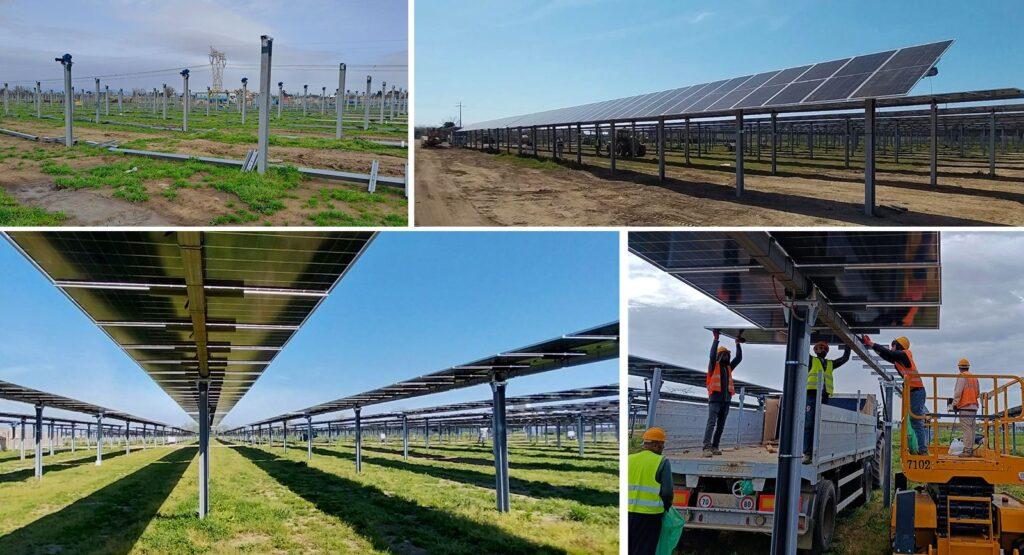
Agrivoltaic projects are reshaping solar development across Europe, particularly in markets like Italy, where integrating renewable energy generation with agricultural activity has become both a regulatory and technical priority.
In this context, single-axis solar trackers (TracSmarT+1P) play a critical role in maximizing energy yield while preserving agricultural use of the land. A clear example is the progress of a 73 MW advanced agrivoltaic project in Italy, currently moving steadily through its final stages of construction, where Gonvarri Solar Steel technology is demonstrating strong performance and adaptability.
What Is Agrivoltaics and Why Is It Growing in Italy?
Agrivoltaic solar trackers allows to combine solar power generation with agricultural production on the same land, enabling dual land use and increased overall productivity.
Italy has emerged as one of the most dynamic markets in this segment, driven by:
- Favorable regulatory frameworks
- Incentive programs for advanced agrivoltaic projects
- The need to balance energy transition with agricultural activity
This trend is driving demand for solar tracking solutions specifically adapted to agrivoltaic requirements.
The Role of 1P Solar Trackers in Agrivoltaic Projects
“What type of solar tracker is best for agrivoltaics?”
1P (one-in-portrait) solar trackers provide key advantages:
- High adaptability to different land configurations
- Improved light distribution for crops
- Adjustable height compatible with farming machinery
- Optimized energy production
In agrivoltaic projects, energy generation must be balanced with agricultural performance — and tracker design is central to achieving that balance.
Progress of the 73 MW Agrivoltaic Project in Italy
The 73 MW agrivoltaic project in Italy, equipped with Gonvarri Solar Steel 1P trackers, is currently in an advanced construction phase.
During these final stages:
- Installation is progressing steadily and efficiently
- Execution timelines are being optimized
- Alignment between engineering design and agricultural requirements is being ensured
Projects of this nature require precise coordination between design, manufacturing, and on-site execution, where the tracker system plays a critical role.
Key Benefits of Solar Trackers in Agrivoltaics
Optimized Land Use
Agrivoltaics enables energy production without displacing agricultural activity, increasing total land productivity.
Increased Energy Yield
Solar trackers enhance irradiation capture compared to fixed-tilt systems, maximizing energy generation.
Adaptability to Agricultural Needs
1P trackers allow configuration flexibility in:
- Structure height
- Row spacing
- Module distribution
This ensures compatibility with crops and farming operations.
Efficient On-Site Execution
Through engineering-driven solutions:
- Installation workflows are streamlined
- Operational complexity is reduced
- Project timelines become more predictable
Advanced Agrivoltaics: A New Standard in Solar Development
“What is advanced agrivoltaics?”
Advanced agrivoltaic projects:
- Integrate agricultural criteria from the design phase
- Optimize coexistence between energy and farming
- Use tailored technologies such as adapted solar trackers
This model represents the next evolution of solar project development in regulated European markets.
Gonvarri Solar Steel: Tracker Technology Adapted to Agrivoltaics
Solar Steel 1P trackers are engineered to meet the demands of both utility-scale and agrivoltaic projects, combining:
- High energy efficiency
- Structural adaptability
- Installation simplicity
The 73 MW project in Italy highlights how engineering-driven design enables reliable execution and supports the transition toward more integrated and sustainable energy models.
What is agrivoltaics?
Agrivoltaics combines solar energy production with agricultural activity on the same land, optimizing land use and productivity.
Which solar trackers are best for agrivoltaics?
1P solar trackers are commonly used due to their flexibility, adaptability, and compatibility with crops.
Why is Italy leading in agrivoltaics?
Italy’s regulatory framework and incentive programs are accelerating the development of advanced agrivoltaic projects.
What are the benefits of agrivoltaics?
It enables dual land use, allowing energy generation while maintaining agricultural production.
How do solar trackers support agrivoltaic projects?
They improve energy yield and provide configurable structures adapted to agricultural requirements.