
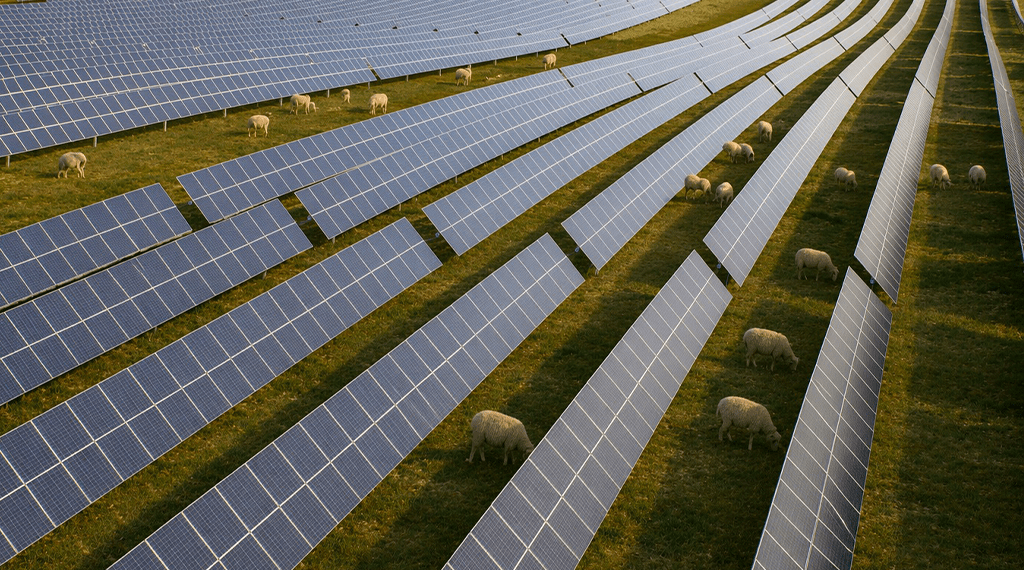
1P Solar Trackers for agrivoltaics
As the global demand for renewable energy continues to grow, agrivoltaics is emerging as one of the most promising approaches to accelerating solar deployment without competing with agricultural land use. By combining photovoltaic energy generation and agricultural activity on the same site, agrivoltaic projects allow developers, landowners, and farmers to maximize land-use efficiency while supporting long-term sustainability goals.
In this evolving market, 1P solar trackers for agrivoltaics have become a critical technology for enabling the successful integration of solar generation and agricultural production. Their ability to optimize energy yield, adapt to specific crop requirements, and maintain agricultural activity beneath the solar array makes them an ideal solution for modern agrivoltaic developments.
Why 1P Solar Trackers Are Essential for Agrivoltaics
Agrivoltaic projects require much more than conventional solar structures. They must be designed to preserve farming operations while delivering the high energy performance expected from utility-scale photovoltaic installations.
1P solar trackers for agrivoltaics provide the flexibility needed to achieve both objectives. By continuously following the sun throughout the day, solar trackers maximize solar irradiation capture and increase energy production compared to fixed-tilt systems. At the same time, elevated configurations allow agricultural activities to continue beneath the photovoltaic installation.
This dual-use approach enables developers to transform land into a productive asset capable of generating both clean electricity and agricultural output without compromising either activity.
Supporting Compliance with Evolving Agrivoltaic Regulations
Agrivoltaic regulation is evolving rapidly across Europe and other international markets. New policies increasingly emphasize the preservation of agricultural productivity, efficient land use, and the coexistence of farming and renewable energy generation.
As agrivoltaic standards continue to mature, project developers are seeking technologies that can support compliance with current and future requirements regarding:
- Ground clearance and crop access.
- Machinery operation beneath the solar field.
- Agricultural continuity throughout the project’s lifecycle.
- Land-use efficiency.
- Long-term sustainability objectives.
Gonvarri Solar Steel develops 1P solar trackers for agrivoltaics with these requirements in mind, helping developers create projects that align with the growing expectations of regulators, investors, landowners, and agricultural stakeholders.
Elevated Configurations for Modern Agrivoltaic Projects
One of the most important design considerations in agrivoltaics is maintaining sufficient space between the ground and the photovoltaic structure.
Advanced 1P solar trackers for agrivoltaics can incorporate elevated configurations with up to 2.1 meters (6.9 feet) of ground clearance, allowing agricultural machinery, livestock operations, and crop management activities to continue with minimal restrictions.
This enhanced clearance provides significant advantages for:
- Row crops.
- Specialty crops.
- Grazing applications.
- Mixed agricultural operations.
- Future land-use flexibility.
As agrivoltaic projects move from demonstration sites to large-scale commercial deployment, elevated tracker designs are becoming an increasingly important factor in project success.
Optimizing Land-Use Efficiency Through Smart Tracker Design
Land-use optimization is one of the primary drivers behind agrivoltaic development.
Unlike traditional solar projects that dedicate land exclusively to electricity production, 1P solar trackers for agrivoltaics support a dual-use strategy that maximizes the value generated from every acre or hectare.
By enabling solar generation and agricultural production to coexist, developers can:
- Improve land-use efficiency.
- Support rural economic development.
- Increase project acceptance among local communities.
- Enhance long-term asset value.
- Reduce perceived competition between energy and agriculture.
This approach is particularly valuable in regions where land availability, permitting requirements, and agricultural preservation policies are becoming increasingly important considerations during project development.
Engineering Flexibility for Utility-Scale Agrivoltaics
Not all agrivoltaic projects face the same challenges. Crop types, climate conditions, terrain characteristics, agricultural practices, and regulatory frameworks can vary significantly from one project to another.
For this reason, 1P solar trackers for agrivoltaics must deliver a high level of engineering flexibility.
Gonvarri Solar Steel’s approach focuses on providing adaptable tracker solutions capable of supporting a wide range of agrivoltaic applications while maintaining high energy performance and operational reliability.
Key capabilities include:
- Elevated configurations for agrivoltaic applications.
- Compatibility with modern high-power PV modules.
- Adaptation to varying terrain conditions.
- Reduced earthworks requirements.
- Advanced tracking controls and optimization algorithms.
- Utility-scale deployment capabilities.
These features enable project developers to design solar plants that meet both agricultural and energy-generation objectives while maintaining strong project economics.
A Future-Proof Solution for Sustainable Solar Development
Agrivoltaics is no longer a niche concept. It is becoming a strategic component of the global energy transition, helping address some of the most significant challenges facing both the solar and agricultural sectors.
As governments, investors, utilities, and developers increasingly prioritize sustainable land-use strategies, 1P solar trackers for agrivoltaics are positioned to play a central role in the next generation of solar projects.
By combining solar tracking technology, elevated structural designs, operational flexibility, and agricultural compatibility, these systems enable a smarter use of land while supporting long-term energy and food production goals.
For developers seeking to maximize performance, preserve agricultural value, and future-proof their projects, 1P solar trackers for agrivoltaics represent one of the most effective solutions available today.