
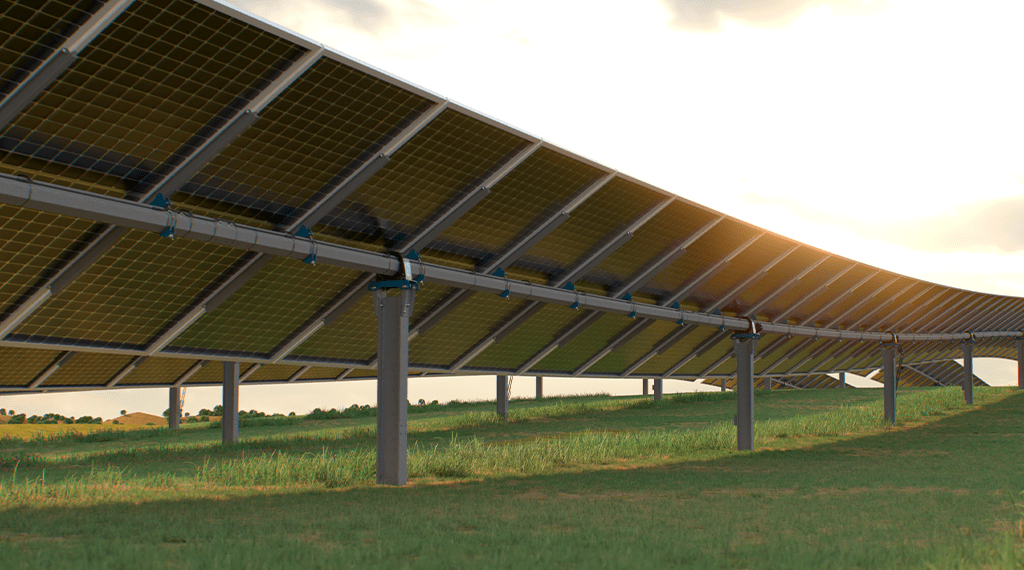
Selecting the right site is one of the most important factors in the success of any photovoltaic project. However, complex terrain conditions often increase construction costs, limit design flexibility, and require extensive earthworks that can negatively impact project economics. This is why terrain-adaptive 1P solar trackers have become a key technology for developers and EPCs seeking to maximize project viability on challenging sites.
With advanced terrain-following capabilities, modern 1P solar trackers can unlock new opportunities in locations that would otherwise be difficult or costly to develop, helping reduce civil works requirements while maintaining high levels of solar performance.
Why Terrain Adaptability Matters in Solar Projects
As the best flat sites become increasingly scarce, developers are expanding into locations with more demanding topography. Sloping terrain, irregular land profiles, and elevation variations can create significant engineering challenges during project development.
Traditional solar plant designs often require extensive grading and land preparation to accommodate these site conditions. While effective, these earthworks can increase CAPEX, extend construction schedules, and generate additional environmental impacts.
For this reason, terrain adaptability has become a critical requirement when evaluating 1P solar trackers for utility-scale solar projects.
SmarTSlope Technology: Designed for Challenging Terrain
Solar Steel’s 1P solar trackers incorporate SmarTSlope technology, specifically engineered to adapt to complex terrain conditions while maintaining optimal tracker performance.
The system is capable of accommodating slopes and variations greater than 1° between piles, allowing projects to adapt more naturally to existing land conditions. By following the terrain profile more efficiently, developers can significantly reduce the amount of grading required during construction.
In many projects, this capability can substantially minimize earthworks requirements. In certain site conditions, it may even eliminate them as a key consideration within the plant layout strategy.
Reducing Earthworks and Improving Project Economics
One of the main advantages of terrain-adaptive 1P solar trackers is their direct impact on project costs.
Reducing earthworks can deliver several important benefits:
- Lower civil works requirements.
- Reduced construction complexity.
- Faster project execution.
- Less environmental disturbance.
- Improved site optimization.
- Better overall project economics.
By minimizing excavation, grading, and soil movement activities, developers can improve project feasibility while preserving the natural characteristics of the site.
This reduction in construction costs can also contribute to a more competitive Levelized Cost of Energy (LCOE), helping maximize long-term project value.
Greater Flexibility for Utility-Scale Solar Development
Not every project is located on ideal terrain. Many of today’s most attractive solar opportunities are found on irregular sites, rolling landscapes, or areas with significant topographical variations.
This is where terrain-adaptive 1P solar trackers provide a decisive advantage.
Their ability to accommodate complex terrain allows developers and EPCs to maintain greater flexibility during the design phase, expanding the number of viable locations for solar deployment and reducing the compromises often associated with challenging land conditions.
Whether the project is located on uneven terrain, sloped sites, or regions with demanding geographical characteristics, advanced 1P solar trackers help maximize land utilization while maintaining high energy production levels.
Unlocking More Solar Potential with 1P Solar Trackers
As utility-scale solar projects continue to expand into increasingly diverse environments, flexibility and adaptability are becoming as important as performance.
Solar Steel’s 1P solar trackers are engineered to help developers unlock more project potential by reducing land constraints, lowering civil works requirements, and optimizing overall plant economics.
By combining high-performance solar tracking with advanced terrain-adaptive capabilities, these solutions enable solar projects to be developed in locations that were once considered difficult, helping maximize energy generation while reducing compromise.